Xerox parc
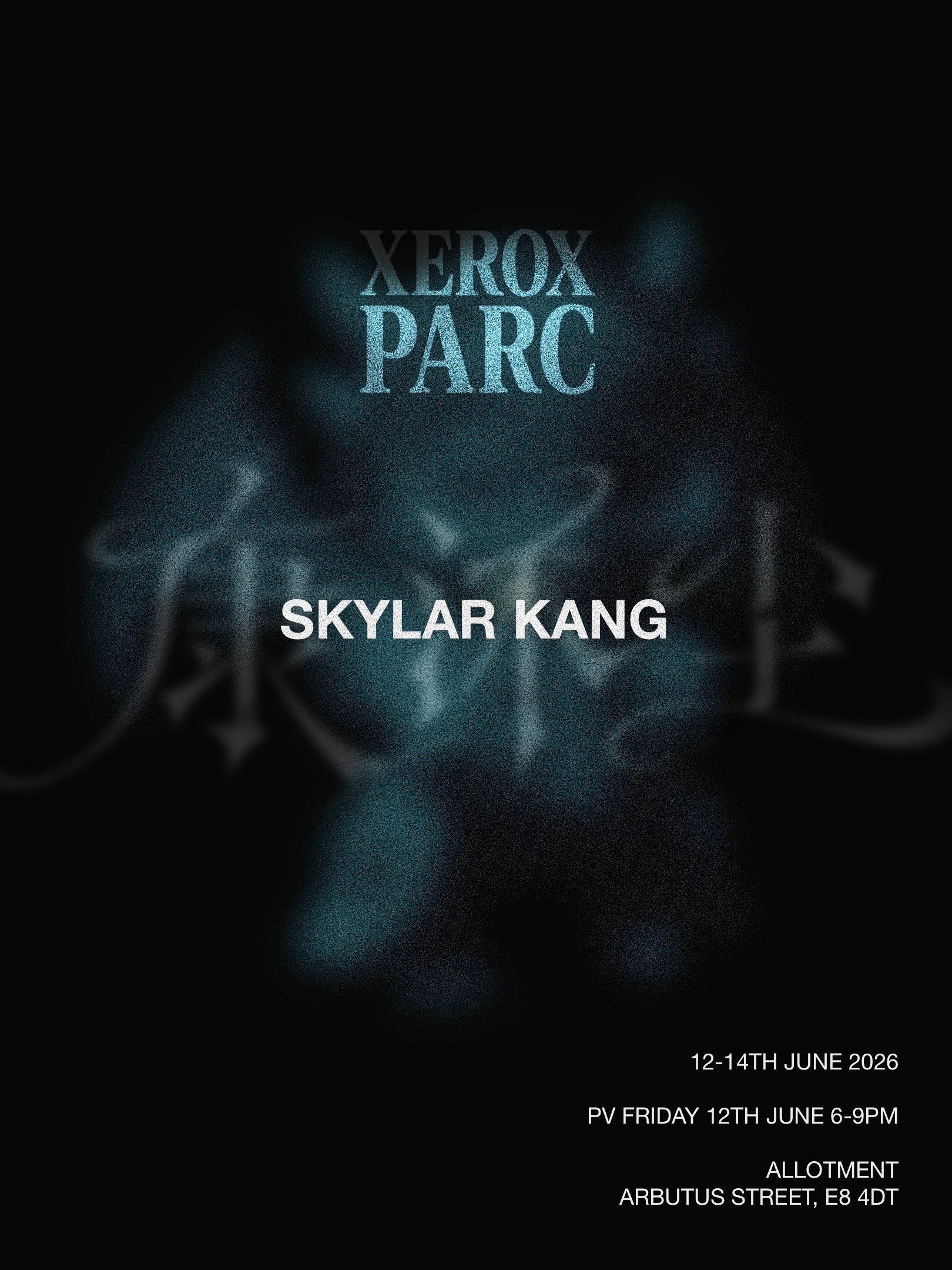
Solo Exhibition by Skylar Kang
Allotment Gallery, Arbutus St, E8 4DT
June 12-14, 2026
Skylar Kang, Xerox PARC
PV: Friday, June 12th 6-9pm
Open: Saturday June 13th - Sunday June 14th 1-6pm
Location: Allotment, Unit 8, Arbutus Street, London E8 4DT
Some systems organise information. Others organise belief. The most enduring ones organise perception.
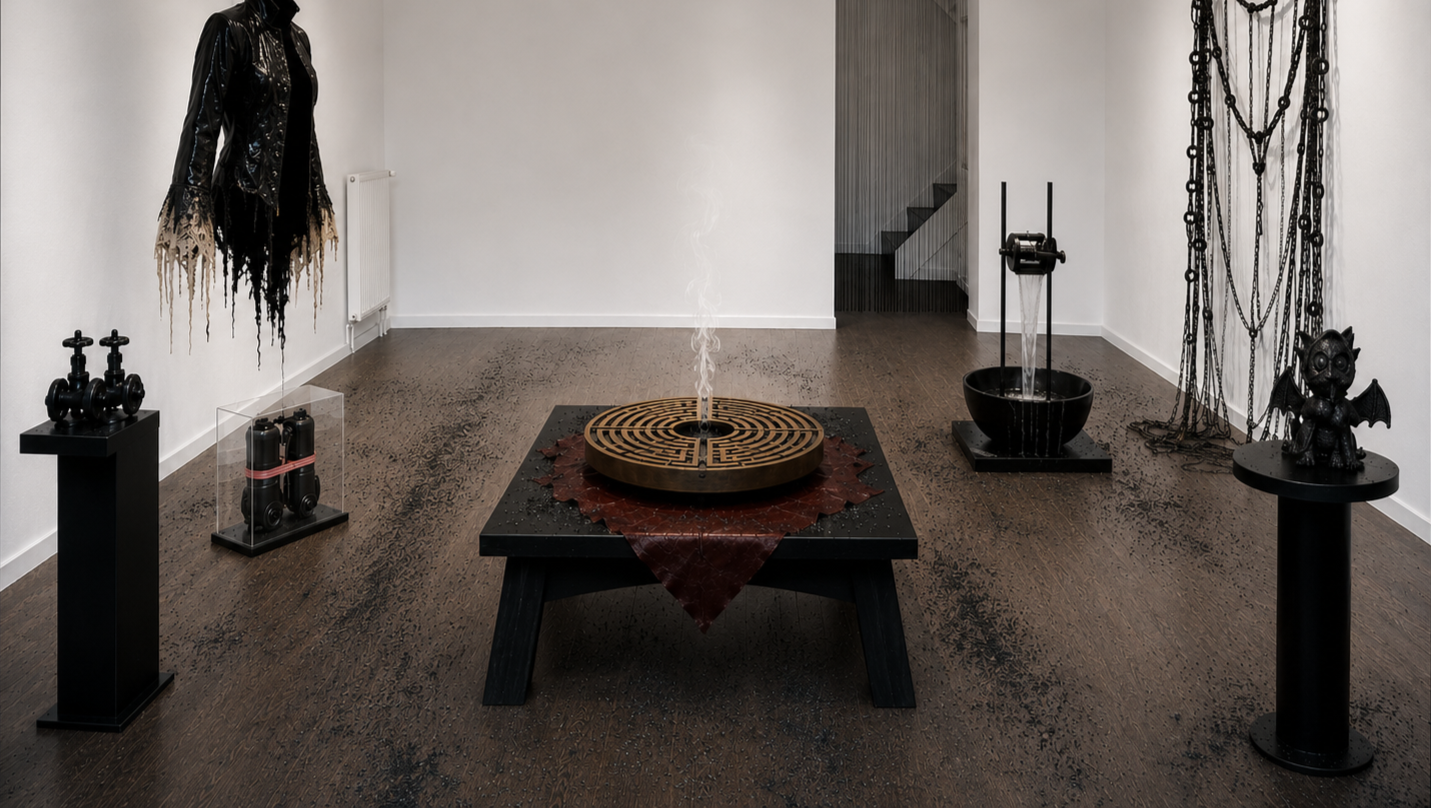
Named after the legendary research laboratory responsible for many of the foundational concepts of ubiquitous computing, Xerox PARC presents a new body of work by London-based artist Skylar Kang. Working across sculpture, responsive materials, light, sound, scent, and installation, Kang investigates the systems through which knowledge, memory, and relation move through the world. Rather than approaching technology as a category of objects, she treats it as a framework for perception: a way of organising attention, shaping reality, and determining what becomes visible, legible, or true.
Circuitry begins to resemble cosmology. Networks echo kinship structures. Across the works, seemingly distant systems begin to reveal unexpected similarities, suggesting that the desire to preserve memory, transmit knowledge, and navigate uncertainty may be among humanity's oldest and most enduring impulses. Drawing from archival practice, contemporary computing, Eastern cosmology, divination systems, and historical technologies of transmission, Xerox PARC explores how different cultures have developed frameworks for navigating forces larger than themselves. Incense clocks, scholar's rocks, genealogical records, cosmological diagrams, archives, and networks are approached not as separate categories, but as parallel attempts to orient human experience—systems through which uncertainty becomes legible and relation acquires form.
Underlying the exhibition is an interest in forms of knowledge that emerge through relation rather than representation. Across traditions such as Daoism, Traditional Chinese Medicine and ancestral systems of record-keeping, the world is understood not as a collection of discrete objects but as a field of relations in continuous transformation. This understanding informs Kang's approach to technology, which is treated less as a collection of devices than as one expression of a much older human project: organising complexity, transmitting knowledge, and making sense of forces that exceed individual perception.
At the centre of the exhibition is a fascination with transmission. Heat moves through conductive thread, subtly transforming resin forms from within. Light behaves simultaneously as signal and apparition. Sound propagates between bodies and objects. Combustion traces pathways through space and time. Throughout the exhibition, materials become carriers, receivers, archives, and witnesses. The works do not simply represent transmission; they perform it.
At the same time, Xerox PARC asks what happens when these systems become so familiar that we stop recognising them as systems at all. The infrastructures that most profoundly shape contemporary life often do so by becoming ambient. Like language, they recede into the background of experience. Their influence lies precisely in their invisibility. Working through materials that oscillate between the industrial and the intimate, the ancient and the contemporary, the visible and the unseen, Kang creates environments animated by propagation rather than representation. Information acquires material weight. Memory becomes a property of matter. The distinction between the engineered and the natural begins to soften. What emerges is a landscape structured not by objects but by flows: of information, sensation, inheritance, and relation.
Marking the beginning of an ongoing research trajectory, Xerox PARC proposes transmission as a material condition and relation as a cultural one. Rather than separating technology from memory, spirituality, kinship, or craft, the exhibition asks how these systems of orientation become atmosphere, how inherited structures shape perception, and how information moves through worlds.